A Path to Peace by george j. mitchell alon sachar
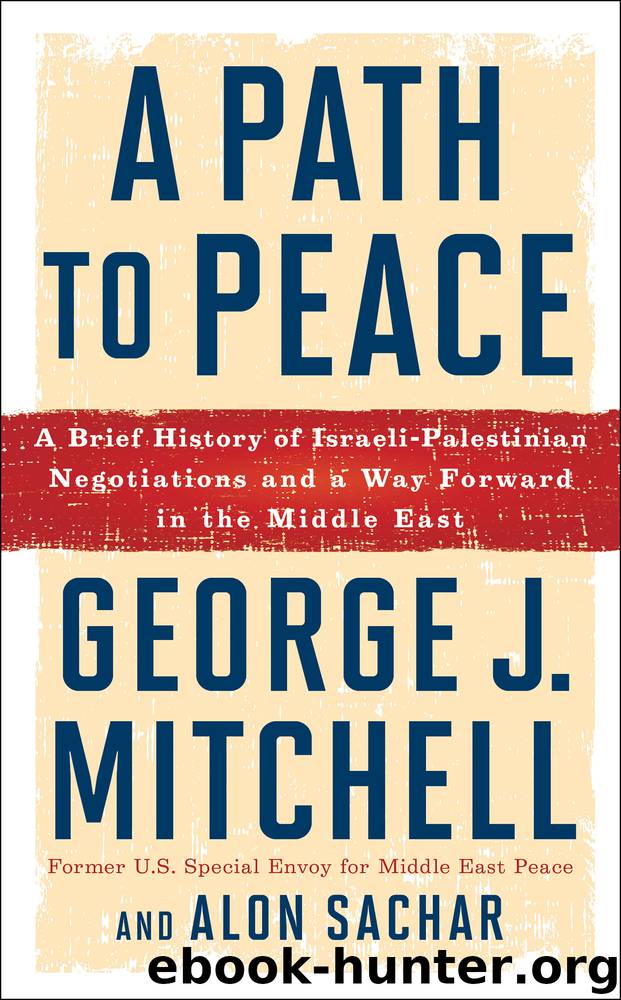
Author:george j. mitchell, alon sachar
Language: eng
Format: epub
Published: 2018-10-15T16:00:00+00:00
9
ISRATINE
T he day after Barack Obama’s first inauguration Muammar Gaddafi, then the undisputed leader of Libya, published an op-ed in the New York Times denigrating years of “desperate diplomacy” to solve the conflict between Israel and the Palestinians. “A just and lasting peace,” he wrote, “is possible but it lies in the history of the people of this conflicted land, and not in the tired rhetoric of partition and two-state solutions. . . . The compromise is one state for all.” 1 Though Gaddafi has long since been disgraced, the idea for a state he called “Isratine” is no joke. Indeed talk of a one-state solution has become more common on both ends of the political spectrum.
Growing extremism, failed negotiations, Israeli settlement expansion, Palestinian disunity—many have become disillusioned with the conflict’s entrenchment. Carlo Strenger, an editorialist for the left-leaning Israeli periodical Haaretz, wrote in 2012, “There are moments when the truth flies into your face and you realize your political program is no longer viable. But while I have no alternative to offer, I know one thing is sure: the two-state solution is dead.” 2 We believe Strenger’s requiem was premature, but the death of the two-state solution is exactly what its supporters warn Israel of.
Their argument is grounded in part in demographics. Today in the territory of the former British Mandate for Palestine (Israel, the West Bank, and Gaza) there are an almost equal number of Jews and Arabs—about 6.2 million each. 3 Because of demographics, Israel cannot permanently hold on to the Palestinian territories without either denying the Palestinians full citizenship and repudiating Israel’s democracy, or granting the Palestinians the right to vote and surrendering Jewish self-determination. But this is a false paradigm in that it presents territorial maximalism—a binational or undemocratic one-state solution—as a viable alternative, which it is not.
We need not look beyond these very lands to foresee the likely result of ethnic competition under one government: it was the incompatibility of Jewish and Arab national, cultural, and political aspirations in the British Mandate for Palestine that led to Israeli-Palestinian partition in the first place. Violent attacks and retributions were constant; tragedy spared few. And the consequences of ethnic and political tensions in Israel today are worrying.
The Israeli Right, including the sitting Justice Minister, have regularly attacked the structure and independence of Israel’s Supreme Court. The Knesset has passed bills that have been criticized by the political left as veiled attempts to discourage political activism and NGO activities. In late 2014 and early 2015, the Knesset seriously considered what has been labeled the Jewish Nation State bill, which aimed to more explicitly anchor Israel’s Jewish identity in the state’s laws by, for example, removing Arabic, the native tongue of twenty percent of Israel’s population, as one of the state’s official languages. The bill has been shelved for the time being, though many expect that it will resurface in the coming years.
In the March 2015 Israeli elections, in a last-ditch effort to persuade his base to vote, Prime Minister Netanyahu warned of Arab voters “heading to the polling station in droves.
Download
This site does not store any files on its server. We only index and link to content provided by other sites. Please contact the content providers to delete copyright contents if any and email us, we'll remove relevant links or contents immediately.
| Arms Control | Diplomacy |
| Security | Trades & Tariffs |
| Treaties | African |
| Asian | Australian & Oceanian |
| Canadian | Caribbean & Latin American |
| European | Middle Eastern |
| Russian & Former Soviet Union |
The Secret History by Donna Tartt(18971)
The Social Justice Warrior Handbook by Lisa De Pasquale(12172)
Thirteen Reasons Why by Jay Asher(8856)
This Is How You Lose Her by Junot Diaz(6845)
Weapons of Math Destruction by Cathy O'Neil(6229)
Zero to One by Peter Thiel(5743)
Beartown by Fredrik Backman(5691)
The Myth of the Strong Leader by Archie Brown(5474)
The Fire Next Time by James Baldwin(5398)
How Democracies Die by Steven Levitsky & Daniel Ziblatt(5183)
Promise Me, Dad by Joe Biden(5120)
Stone's Rules by Roger Stone(5060)
A Higher Loyalty: Truth, Lies, and Leadership by James Comey(4923)
100 Deadly Skills by Clint Emerson(4888)
Rise and Kill First by Ronen Bergman(4747)
Secrecy World by Jake Bernstein(4711)
The David Icke Guide to the Global Conspiracy (and how to end it) by David Icke(4664)
The Farm by Tom Rob Smith(4475)
The Doomsday Machine by Daniel Ellsberg(4463)
